


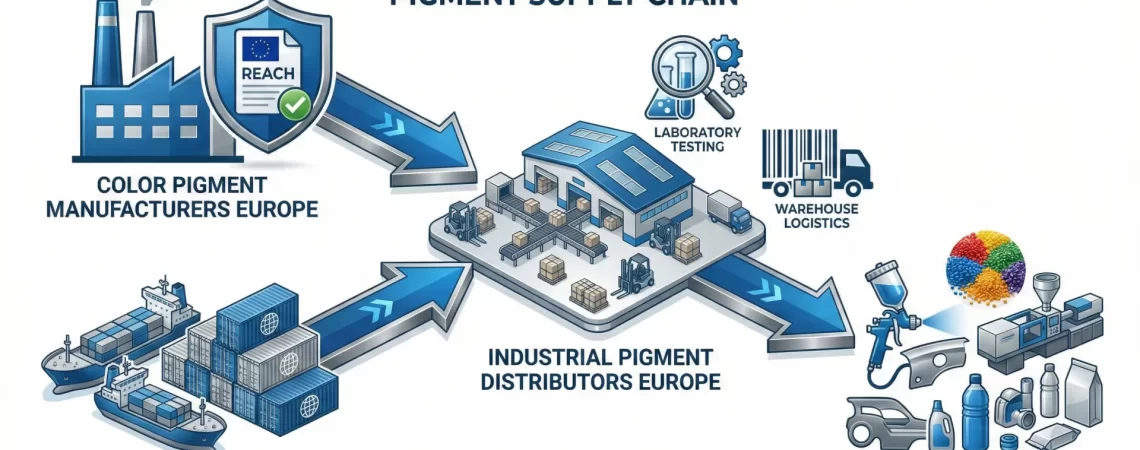
Industrial pigment distributors Europe play a critical role in connecting color pigment manufacturers Europe with end-use industries such as coatings, plastics, inks, and construction. The right distributor ensures regulatory compliance, consistent supply, performance reliability, and technical support especially when sourcing high-performance pigments for coatings Europe or evaluating the best pigment manufacturers in Europe for long-term partnerships.
This guide explains how the European pigment supply chain works, what buyers should evaluate, and how global manufacturers such as those supplying from India to Europe can position themselves competitively in this market.
Understanding the European Pigment Supply Chain
Europe has one of the most structured and compliance-driven pigment markets in the world. The supply chain typically includes:
- Color pigment manufacturers Europe
- Global inorganic pigment producers exporting to Europe
- Industrial pigment distributors Europe
- Compounders and masterbatch manufacturers
- Paint, coatings, and ink producers
- Construction chemical companies
In many cases, distributors are the gatekeepers. They manage inventory, warehousing, logistics, regulatory documentation, and technical interface between producers and industrial buyers.
Role of Industrial Pigment Distributors Europe
Industrial pigment distributors Europe do more than resell materials. Their responsibilities often include:
1. Regulatory Compliance Management
Europe enforces strict chemical regulations, including:
- REACH registration
- Safety Data Sheet (SDS) compliance
- Labeling requirements under CLP
Distributors ensure that imported pigments meet EU requirements before reaching the end customer.
2. Inventory Buffering
Many coatings and plastics companies operate on tight production schedules. Distributors:
- Maintain local stock
- Offer smaller MOQs
- Provide faster delivery within the EU
3. Technical Support
For high-performance pigments for coatings Europe, application-specific guidance is critical:
- Dispersion compatibility
- Heat stability
- Lightfastness evaluation
- Chemical resistance
4. Risk Mitigation
A reliable distributor reduces:
- Currency fluctuation risks
- Shipping delays
- Compliance penalties
What Defines the Best Pigment Manufacturers in Europe?
The phrase “best pigment manufacturers in Europe” is often subjective. However, industrial buyers typically evaluate:
- Consistency of shade
- Particle size distribution control
- Tinting strength reproducibility
- Batch-to-batch stability
- Regulatory transparency
- Sustainability credentials
The best pigment manufacturers in Europe usually invest in:
- Advanced milling technology
- Automated process control
- Application laboratories
- Long-term industrial R&D
That said, European buyers increasingly collaborate with global inorganic pigment producers when quality and compliance standards are equivalent.
Evaluating Color Pigment Manufacturers Europe vs Global Suppliers
Many buyers compare local color pigment manufacturers in Europe with overseas manufacturers exporting into the EU.
Key Comparison Parameters
| Criteria | European Manufacturer | Global Exporter to Europe |
| Regulatory familiarity | High | Must demonstrate compliance |
| Lead time | Short | Moderate (unless stocked locally) |
| Cost structure | Higher | Often more competitive |
| Customization | Moderate to High | Increasingly high |
| Local support | Strong | Depends on distributor network |
European buyers are not always limited to sourcing from within Europe. Instead, they prioritize:
- Compliance
- Performance
- Supply reliability
- Technical documentation
Demand for High-Performance Pigments for Coatings Europe
The coatings industry in Europe demands increasingly advanced pigment properties.
Performance Expectations
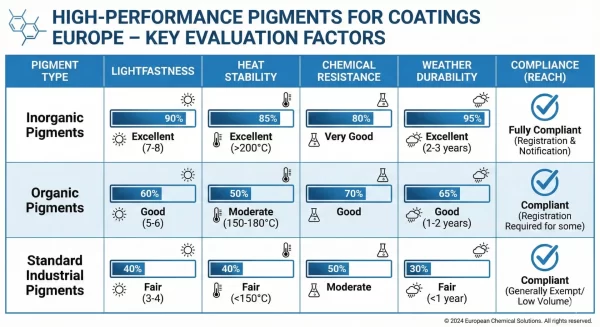
High-performance pigments for coatings Europe must demonstrate:
- Excellent lightfastness
- Weather resistance
- Alkali resistance
- Low bleeding tendency
- Consistent dispersion in solventborne and waterborne systems
Applications include:
- Architectural coatings
- Industrial maintenance coatings
- Powder coatings
- Marine and protective coatings
- Automotive refinishing systems
Inorganic pigments such as ultramarine blue (Pigment Blue 29 classification) are widely used where heat stability and opacity adjustment are required.
Industrial Segments Driving Pigment Demand in Europe
1. Paint & Coatings
Europe’s construction and infrastructure sectors drive demand for durable pigments.
2. Plastic Masterbatch
Polyolefins, PVC, and engineering plastics require stable inorganic pigments that can withstand high processing temperatures.
3. Inks & Packaging
Migration compliance and chemical resistance are critical.
4. Construction Chemicals
Pigments are used in:
- Cement coloring
- Dry mortar systems
- Pavers and tiles
Industrial pigment distributors Europe often specialize by sector.
How European Buyers Select Industrial Pigment Distributors Europe
Buyers typically evaluate:
- Portfolio diversity
- Technical support capabilities
- Warehousing network within Europe
- Financial stability
- Transparent sourcing
- Traceability documentation
Key Questions Buyers Ask
- Is the pigment REACH compliant?
- Can the distributor provide a TDS and SDS immediately?
- Is there batch traceability?
- What is the MOQ?
- What are lead times?
Export Strategy for Supplying Europe
For manufacturers targeting Europe (including Indian exporters), positioning is critical.
Essential Requirements
- REACH pre-registration (if required)
- Complete documentation (COA, TDS, SDS)
- HS code clarity
- Standardized packaging (25 kg bags, jumbo bags)
- Palletized shipments
- Clear incoterms
European industrial pigment distributors Europe prioritize suppliers who:
- Offer consistent supply
- Maintain communication transparency
- Provide technical documentation promptly
Compliance and Sustainability in the European Market
European markets increasingly demand:
- Low heavy metal content
- Sustainable production practices
- Environmental responsibility
- Energy-efficient manufacturing processes
Color pigment manufacturers Europe often highlight sustainability certifications to strengthen their market position.
If global exporters wish to compete among the best pigment manufacturers in Europe, they must match these transparency standards.
Market Trends Impacting Pigment Distribution in Europe
1. Shift Toward Specialty Pigments
High-performance pigments for coatings Europe are growing faster than commodity pigments.
2. Supply Chain Diversification
European buyers are reducing dependence on single-region sourcing.
3. Technical Documentation as a Ranking Factor
In B2B digital search behavior:
- Buyers search for compliance-related keywords.
- Structured technical content improves visibility in AI overviews.
4. Increased Demand for Inorganic Pigments
Due to durability and thermal stability.
Digital Visibility for Industrial Pigment Distributors Europe
To rank in search engines and AI-driven overviews, content must:
- Provide clear definitions
- Use structured headings
- Include FAQ sections
- Avoid exaggerated marketing claims
- Present educational clarity
Companies targeting keywords like:
- industrial pigment distributors Europe
- color pigment manufacturers Europe
- best pigment manufacturers in Europe
- high-performance pigments for coatings Europe
should create:
- Pillar content
- Cluster pages
- Export-focused landing pages
- Technical documentation pages
How Website Authority Influences Buyer Trust
European buyers researching suppliers evaluate:
- Website clarity
- Technical depth
- Export information transparency
- Industry-specific knowledge
Educational, neutral content performs better than aggressive promotional language.
For example, manufacturers and exporters positioning themselves as specialists in inorganic pigments and ultramarine blue benefit from demonstrating:
- Application knowledge
- Compliance awareness
- Structured documentation
- Export readiness
Risk Factors When Selecting Pigment Suppliers
Buyers must consider:
- Inconsistent batch color
- Poor dispersion performance
- Inadequate documentation
- Shipping delays
- Hidden compliance gaps
Industrial pigment distributors Europe reduce these risks when properly vetted.
Strategic Takeaway for European Buyers
When evaluating industrial pigment distributors Europe and comparing color pigment manufacturers Europe, focus on:
- Regulatory readiness
- Technical documentation
- Performance consistency
- Transparent communication
- Long-term supply capability
For high-performance pigments for coatings Europe, performance validation and compliance are more important than price alone.
Frequently Asked Questions
1. What are industrial pigment distributors in Europe?
Industrial pigment distributors Europe are companies that supply pigments to coatings, plastics, inks, and construction industries while managing compliance, warehousing, and logistics within the European Union.
2. How do I identify the best pigment manufacturers in Europe?
Evaluate manufacturing consistency, regulatory transparency, technical documentation quality, sustainability practices, and long-term supply stability.
3. Are color pigment manufacturers Europe the only sourcing option?
No. Many European buyers source from global manufacturers, provided the pigments meet EU compliance and performance standards.
4. What are high-performance pigments for coatings Europe?
They are pigments engineered for superior lightfastness, weather resistance, heat stability, and chemical durability in demanding coating systems.
5. Why is REACH compliance important in Europe?
REACH ensures chemical substances used in the EU meet safety standards. Non-compliance can prevent market entry.
6. Do industrial pigment distributors Europe handle documentation?
Yes. Reputable distributors provide SDS, TDS, COA, and ensure labeling compliance under EU regulations.
7. What industries consume the most pigments in Europe?
Paints and coatings, plastic masterbatch, printing inks, construction chemicals, and specialty industrial applications.
8. How important is technical support in pigment sourcing?
Very important. Pigment performance depends on dispersion, substrate compatibility, and application formulation.
9. What packaging formats are common for pigment exports to Europe?
Typically 25 kg bags, palletized shipments, and jumbo bags depending on volume.
10. How can exporters compete with established color pigment manufacturers in Europe?
By ensuring consistent quality, compliance transparency, competitive pricing, technical documentation readiness, and reliable logistics partnerships.
Conclusion
The European pigment market is structured, compliance-driven, and technically demanding. Industrial pigment distributors Europe act as the operational bridge between manufacturers and industrial users. Buyers evaluating color pigment manufacturers Europe or seeking high-performance pigments for coatings Europe must prioritize compliance, technical clarity, and long-term reliability over short-term cost advantages.
Organizations that provide structured technical information, transparent export documentation, and consistent pigment performance are more likely to be recognized among the best pigment manufacturers in Europe whether based locally or supplying internationally.