


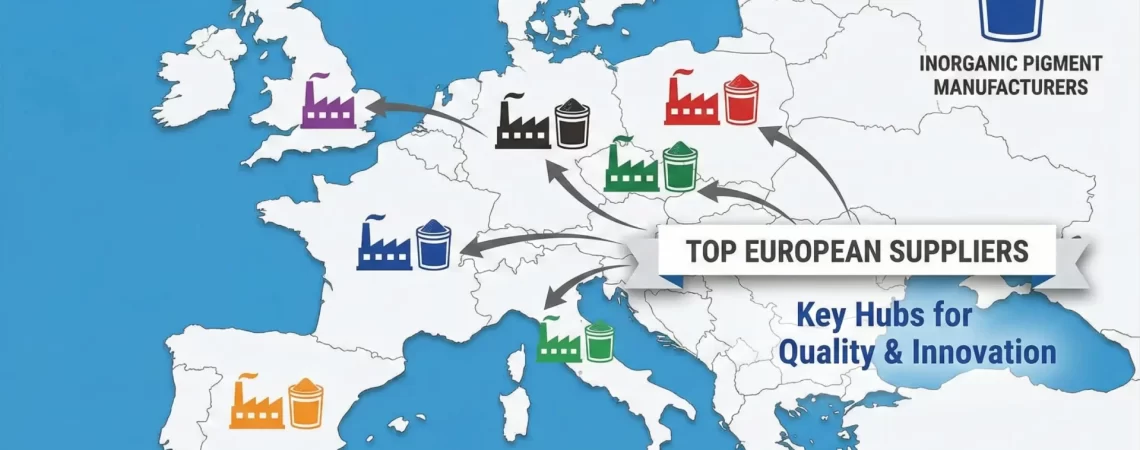
Introduction: Industrial Pigments for the European Manufacturing Market
Inorganic pigments remain a critical raw material for Europe’s industrial ecosystem, supporting large-scale production in plastics, coatings, inks, rubber, ceramics, and construction materials. As European regulations tighten around product safety, environmental compliance, and supply chain traceability, industrial buyers are increasingly selective when sourcing pigments.
For procurement managers, R&D teams, and importers, identifying reliable inorganic pigment manufacturers Europe is no longer just about color availability. It involves evaluating technical performance, batch consistency, compliance with European standards, and long-term supply reliability.
India has emerged as a strategic manufacturing and export hub for inorganic pigments, supplying industrial pigment distributors in Europe, private-label buyers, and OEM manufacturers with consistent quality at scale. This guide explains how industrial buyers assess the best pigment manufacturers for Europe, what technical parameters matter, and how to select export-ready suppliers aligned with European market expectations.
What Are Inorganic Pigments and Why They Matter in Europe
Inorganic pigments are mineral-based colorants produced through controlled chemical processes using metal oxides, sulfides, silicates, and other inorganic compounds. Unlike organic pigments, inorganic pigments are known for:
- High thermal stability
- Excellent lightfastness
- Chemical resistance
- Long-term color durability
These properties make inorganic pigments essential for European industries where product longevity and regulatory compliance are non-negotiable.
Across Europe, color pigment manufacturers rely heavily on inorganic pigments for applications requiring consistent performance under harsh environmental and processing conditions.
Chemical Composition and Key Performance Properties
From a technical perspective, inorganic pigments derive their performance from stable crystalline structures. Common properties evaluated by European industrial buyers include:
- Heat resistance: Essential for plastic masterbatch and polymer processing
- Weather stability: Required for coatings, construction, and outdoor applications
- Chemical inertness: Important in inks, rubber, and industrial coatings
- Opacity and tinting strength: Critical for cost-effective formulation
Inorganic pigments such as Ultramarine Blue (Pigment Blue 29), iron oxides, chromium oxides, and mixed metal oxides are widely used by industrial pigment distributors in Europe due to their proven long-term stability.
High-Level Manufacturing Process for Export-Grade Inorganic Pigments
Industrial buyers in Europe often evaluate pigment suppliers based on their manufacturing discipline rather than just end-product appearance. Export-grade inorganic pigments typically involve:
- Raw material selection based on purity and traceability
- Controlled calcination or synthesis processes to achieve uniform crystal structure
- Particle size optimization for dispersion efficiency
- Post-processing and quality testing to ensure batch-to-batch consistency
For export markets, manufacturers must align production with international quality systems and documentation protocols expected by European buyers.
Applications of Inorganic Pigments Across European Industries
Inorganic Pigments for Plastic Masterbatch
Plastic masterbatch manufacturers in Europe rely on inorganic pigments for applications requiring high processing temperatures and long service life. Inorganic pigments offer:
- Stable color during extrusion and injection molding
- Minimal migration or bleeding
- Consistent dispersion in polymer matrices
This makes them suitable for packaging, automotive plastics, construction profiles, and consumer durable components.
Pigments for Plastics and Polymers
Beyond masterbatch, inorganic pigments are widely used in compounded plastics and engineered polymers. European polymer processors value inorganic pigments for:
- UV stability
- Resistance to chemical exposure
- Low reactivity with polymer additives
These characteristics are essential in technical plastics used in industrial and infrastructure projects.
Pigments for Paints and Coatings
In Europe’s coatings sector, inorganic pigments play a vital role in architectural, industrial, and protective coatings. Key advantages include:
- Long-term color retention
- Resistance to weathering and corrosion
- Compatibility with water-based and solvent-based systems
For this reason, best pigment manufacturers in Europe and their global supply partners prioritize inorganic pigments for high-performance coatings.
Inks, Rubber, and Ceramic Applications
Inks used for industrial printing, rubber goods, and ceramic applications require pigments that maintain color integrity under pressure, heat, and chemical exposure. Inorganic pigments deliver consistent results in:
- Packaging and decorative inks
- Rubber compounds for industrial goods
- Ceramic glazes and construction materials
Why European Buyers Source from Indian Inorganic Pigment Manufacturers
While Europe has established pigment producers, many industrial pigment distributors in Europe increasingly partner with Indian manufacturers for strategic reasons.
Cost Efficiency Without Performance Compromise
Indian manufacturers operate at scale, enabling competitive pricing while maintaining technical quality. This cost advantage is critical for European buyers facing margin pressure.
Bulk Production Capability
Export-oriented Indian pigment manufacturers are equipped for large-volume supply, supporting long-term contracts and stable inventory planning for European distributors.
Global Compliance Orientation
Export-focused manufacturers align production with international regulatory frameworks, enabling smoother entry into regulated markets such as the EU.
Proven Export Experience
India has become a trusted pigment export base, supplying to Europe, the Middle East, Southeast Asia, and Africa. This experience translates into reliable logistics, documentation accuracy, and shipment consistency.
Export and Bulk Supply Information for Europe
Packaging Options
Export-grade inorganic pigments are typically supplied in:
- Multi-layer paper bags
- HDPE woven bags with liners
- Jumbo bags for bulk shipments
Packaging is selected based on shipment size, handling requirements, and end-use application.
Quality Standards and Batch Consistency
European buyers expect strict adherence to internal quality benchmarks, including:
- Particle size control
- Shade consistency
- Moisture limits
- Contamination prevention
Batch-to-batch consistency is a decisive factor when selecting long-term pigment suppliers.
Typical Export Markets Served
Export-oriented inorganic pigment manufacturers from India regularly supply to:
- Europe (Germany, Italy, Eastern Europe)
- UAE and Middle East
- Turkey
- Southeast Asia
- Africa
This geographic reach demonstrates logistical capability and adaptability to different market requirements.
How to Select the Right Inorganic Pigment Supplier for Europe
For European buyers evaluating suppliers, selection should extend beyond price comparison.
Technical Support Capability
A reliable supplier provides formulation guidance, dispersion support, and application-specific recommendations aligned with European processing standards.
Quality Control Infrastructure
In-house testing, documented quality procedures, and traceable production records are essential indicators of a dependable manufacturer.
Export Documentation and Compliance
Proper export documentation, consistent labeling, and adherence to import regulations ensure smooth customs clearance and reduced risk for European importers.
Customization and Product Adaptability
European manufacturers often require pigments tailored to specific performance parameters. Suppliers capable of customization offer a clear strategic advantage.
Frequently Asked Questions
1. What industries in Europe use inorganic pigments the most?
Inorganic pigments are widely used in plastics, coatings, construction materials, inks, rubber, and ceramics across European manufacturing sectors.
2. Are inorganic pigments suitable for plastic masterbatch production?
Yes. Inorganic pigments offer excellent heat stability, dispersion consistency, and long-term color retention, making them ideal for plastic masterbatch applications.
3. How do inorganic pigments differ from organic pigments?
Inorganic pigments generally provide higher thermal and light stability, while organic pigments offer brighter shades but lower durability in demanding industrial conditions.
4. Can inorganic pigments be exported to Europe in bulk quantities?
Yes. Export-oriented manufacturers routinely supply inorganic pigments to Europe in bulk packaging formats suitable for industrial handling.
5. What packaging options are available for pigment exports to Europe?
Common packaging includes HDPE woven bags, multi-layer paper bags, and jumbo bags, depending on shipment volume and buyer requirements.
6. Do European buyers require consistent batch quality?
Absolutely. Batch-to-batch consistency is critical for European manufacturers to maintain uniform product performance and color output.
7. Are Indian manufacturers reliable suppliers for Europe?
Many Indian inorganic pigment manufacturers have extensive export experience and established supply relationships with European distributors.
8. Can pigments be customized for European formulations?
Yes. Export-focused manufacturers often provide customization in particle size, shade, and dispersion characteristics based on application needs.
9. Which European markets commonly import inorganic pigments?
Germany, Italy, Eastern Europe, Turkey, and other EU regions are major importers of industrial inorganic pigments.
10. How should European buyers evaluate pigment suppliers?
Buyers should assess technical capability, quality systems, export experience, documentation accuracy, and long-term supply reliability.
Final Note
For European manufacturers and distributors, sourcing from experienced global suppliers is a strategic decision. The best inorganic pigment manufacturers are those that combine technical reliability, export discipline, and consistent supply, ensuring uninterrupted production and long-term commercial stability.